 Sparkfi
 Use Cases From Collateral Loans to SPK Farming
Sparkfi supports collateral-backed loans, savings deposits, and USDS deposits that earn SPK through farming. SparkLend combines collateral in pooled positions, while Morpho-powered Isolated Markets keep each lending pair separate. Eligible assets and market settings determine borrowing capacity, while farming and staking create different reward balances and exit conditions.
Last updated ·Key takeaway: USDS farming earns SPK, while SPK staking earns points and introduces a withdrawal delay tied to the staking epochs.
Collateral Loans Across Pooled and Isolated Markets
Collateral-backed borrowing releases liquidity while retaining exposure to the collateral, with pooled and isolated markets offering different ways to define the lending position.
Combined Collateral in SparkLend
SparkLend supports multiple listed collateral assets within a shared position. Supplying an asset and enabling eligible collateral establish the base for borrowing another listed asset. The market’s caps, liquidity, and asset settings constrain that capacity. Transparent borrow rates stay fixed over short periods but can change through Sky Governance. Variable rates change continuously with supply and demand. Supplied collateral stays within SparkLend reserves rather than moving into external yield strategies.
SparkLend operates on Ethereum. Its Gnosis Chain markets completed deprecation in September 2026, so they no longer allow new supply, borrowing, or collateral use; existing suppliers can still withdraw.
Single-Pair Borrowing Through Morpho
Isolated Markets use Morpho lending pairs, each with one collateral asset and one loan asset. A dedicated oracle and liquidation loan-to-value ratio govern that market’s collateral valuation and liquidation boundary. This structure fits a loan centered on a particular pair, whereas SparkLend combines eligible collateral within one pooled position. Liquidity comes from suppliers and may also come from curator-managed Morpho vaults. The Public Allocator can move additional liquidity from other Morpho markets during the borrow transaction, within curator-set flow caps. The app’s network selector shows which isolated markets are available on each network.
Which Market Parameters Limit a Collateral Loan?
Collateral valuation, liquidation thresholds, and available liquidity constrain a loan, while market-specific caps can further limit the amount that a pooled market accepts or lends.
Borrowed tokens arriving in a wallet do not, by themselves, identify the debt denomination. A SparkLend periphery integration can deliver USDC from a USDS-denominated position through a 1:1 conversion in Sky’s mainnet LitePSM wrapper. The debt remains USDS in that pattern. Its availability depends on the active frontend and periphery contracts; the protocol’s capability alone does not establish that a particular interface offers the route.
| Borrowing Parameter | Value and Position Constraint |
|---|---|
| SparkLend Health Factor | Collateral value adjusted for each asset’s liquidation threshold, divided by debt value; a lower ratio reduces the margin before liquidation. |
| Isolated Market Liquidation LTV (LLTV) | Fixed at creation and shown as Max LTV; crossing the limit can make the position liquidatable. |
| Isolated Market Oracle | Fixed at creation; its collateral-to-loan valuation sets the value used to assess the position. |
| Isolated Market Interest Rate Model | Fixed at creation; the model sets borrow and supply rates from market utilization. |
| SparkLend Supply Cap | A per-market limit configured by Sky Governance; it bounds the total supplied amount of the asset. |
| SparkLend Borrow Cap | A per-market limit configured by Sky Governance; it bounds how much of the asset can be borrowed. |
| Loan Fit | Collateral capacity and liquidity limit new borrowing; collateral valuation and debt continue to affect liquidation exposure. |
SparkLend positions become liquidatable when their health factor falls below 1. Supplying more collateral or repaying debt can raise that ratio. Isolated positions use the same threshold with their market’s LLTV. Submitting a borrow transaction does not establish completion. After execution, check the selected position’s increased debt balance and the tokens received in the wallet.
Sparkfi Use Cases From Collateral Loans to SPK Farming
- Collateral Loans Across Pooled and Isolated Markets
- Which Market Parameters Limit a Collateral Loan?
- Can the Same USDS Earn the Sky Savings Rate and SPK Farm Rewards?
- SPK Staking With a Delayed Exit
Can the Same USDS Earn the Sky Savings Rate and SPK Farm Rewards?
The same funds cannot earn the Sky Savings Rate and SPK farming rewards simultaneously, because entering the farm requires USDS rather than a savings token. sUSDS suits users seeking savings-rate income in USDS; the SPK Farm suits those seeking SPK rewards from a USDS balance.
USDS Funding and SPK Rewards
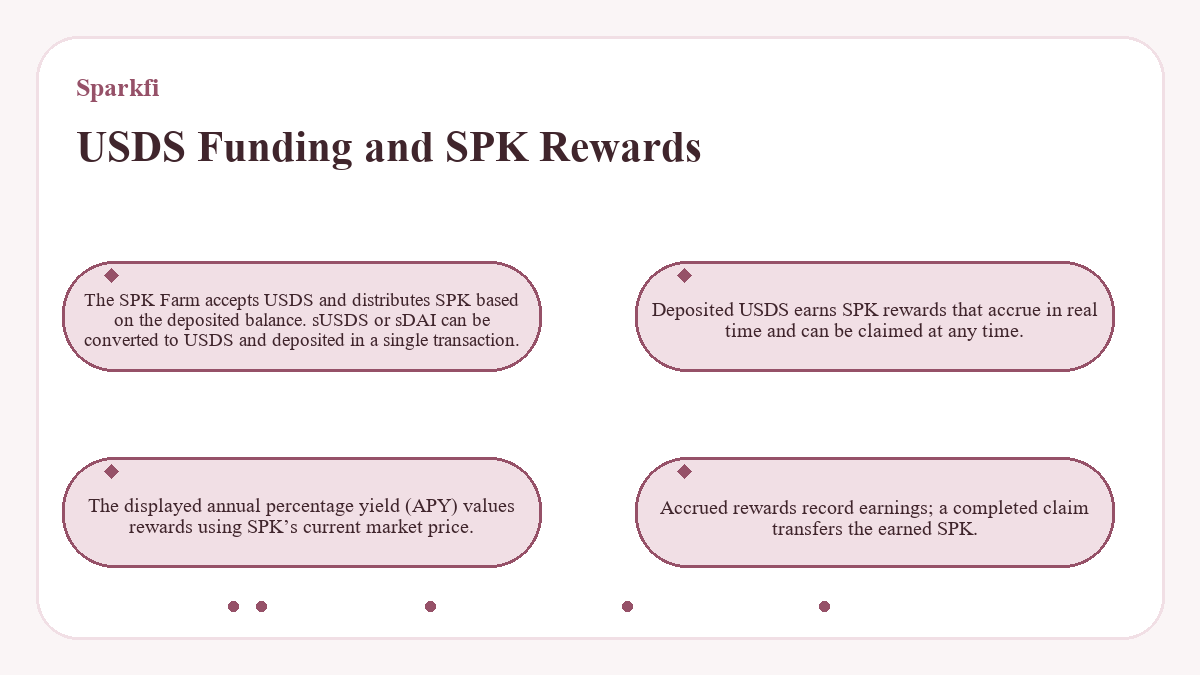
The SPK Farm accepts USDS and distributes SPK based on the deposited balance. sUSDS or sDAI can be converted to USDS and deposited in a single transaction. Deposited USDS earns SPK rewards that accrue in real time and can be claimed at any time. The displayed annual percentage yield (APY) values rewards using SPK’s current market price. Accrued rewards record earnings; a completed claim transfers the earned SPK.
Farm Withdrawals and Capital Use
USDS deposited into the farm remains under the user’s control and does not enter a lending pool or staking mechanism. Farm withdrawals have no liquidity restriction or staking cooldown, and the withdrawal cost is network gas. The farm returns deposited USDS on withdrawal, while reward claims deliver SPK. The value of earned SPK can fluctuate with its market price.
SPK Staking With a Delayed Exit
A withdrawal delay of two to four weeks separates SPK staking from USDS farming when the job requires access to the original tokens.
Spark Points and the Stake Token
SPK staking uses Symbiotic infrastructure and earns Spark Points. Staking produces stSPK, a token that represents the stake and is required for withdrawal. The staking deployment uses stSPK on Ethereum. Staked SPK helps secure token bridges within the Spark Liquidity Layer (SLL) and may support future products. Staking carries slashing risk; the slashing mechanism depends on the product that the stake secures.
Queued Withdrawals and Finalization
SPK withdrawals become claimable after the current two-week epoch and the following epoch both end. Unstaking timing within the current epoch determines the exact delay. Queued SPK continues earning Spark Points. A claimable withdrawal still requires finalization before SPK returns to the wallet. Finalization is an onchain transaction, and returned SPK establishes completion beyond the queue entry.
Savings for Treasury Balances
Savings vaults fit balances intended to earn yield through transferable shares, with the selected vault determining the income source and redemption conditions. Deposits require an asset and network that the chosen vault supports; a completed deposit delivers its share tokens to the wallet. Spark’s V2 vaults generate yield through the Spark Liquidity Layer. spUSDC, spUSDT, and spPYUSD have USDS backing, while spETH relies on Spark’s balance sheet and insurance. Sky’s sUSDS earns the Sky Savings Rate, while stUSDS lends USDS against SKY collateral and carries a different risk profile. Savings vault tokens follow ERC-4626 and represent shares of underlying assets, with yield accruing through the redemption rate.
Savings and farm positions have different exits. V2 USDC and USDT vaults on Ethereum can use Savings Liquidity Intents when a withdrawal exceeds available idle liquidity. The app’s confirmation means that the request was created; fulfillment transfers the withdrawn funds to the wallet automatically. Requests usually settle within minutes, but that timing is not guaranteed. stUSDS can face its own liquidity constraints. Recovery mode can temporarily halt withdrawals when a potential loss affects savings vaults. A balance needed immediately therefore has a different constraint from one that can tolerate an asynchronous redemption. Token transferability does not remove the vault’s liquidity or recovery conditions.
Sparkfi Use Cases From Collateral Loans to SPK Farming
- SPK Staking With a Delayed Exit
- Savings for Treasury Balances
- Where Do Institutional Lending and Liquidity Services Fit?
Where Do Institutional Lending and Liquidity Services Fit?
Institutional Lending supports crypto-backed financing through custodian integrations, while liquidity services supply capital and savings infrastructure to platforms building on Spark.
Institutional Lending structures bespoke, fixed-rate loans against digital asset collateral. Spark Prime combines Arkis portfolio margin technology with SLL liquidity. It extends financing to DeFi and CeFi within a single brokerage framework, including off-exchange settlement. These arrangements fit financing jobs defined by custody integration or portfolio margin.
Liquidity as a Service allocates capital through the SLL to support stablecoin issuers, blockchain teams, and DeFi infrastructure. Governance-approved venues and rate limits constrain these deployments, and service arrangements can specify benchmarks, parameters, and service levels. Embedded Finance supplies savings infrastructure for exchanges, custodians, fintechs, and wallet providers that integrate an earn product. Expanding the SLL’s supported integrations depends on governance-controlled configuration and, where required, controller upgrades.
Sparkfi: questions and answers
Can Staked SPK Still Be Used for Governance Voting?
Staked SPK retains governance voting power for the full amount staked. SPK voting supports signaling and sentiment checks through Snapshot. Governance participation can therefore accompany staking without first withdrawing the tokens, while the staking position remains subject to its own withdrawal schedule and security risks.
When Can Spark Rewards Campaign Tokens Be Claimed?
Spark Rewards campaign tokens become claimable after the weekly Monday distribution. The app distinguishes pending rewards from distributed rewards. Claims can cover accumulated weeks in one transaction, subject to the campaign’s expiry deadline. This weekly schedule belongs to partner-token campaigns; SPK Farm rewards accrue and can be claimed at any time.
How Are Public Allocator Fees Shown Before an isolated-market Borrow?
A borrow using Morpho’s Public Allocator may incur a reallocation fee that the Borrow dialog displays for acknowledgment before confirmation. Standard network transaction fees also apply. The extra charge belongs to liquidity reallocation through that route, so it should not be treated as a fee on every isolated-market interaction.
What Happens to an Existing Gnosis SparkLend Borrow After Deprecation?
Remaining Gnosis SparkLend borrow positions became liquidatable when the September 10, 2026 deprecation spell executed. After liquidation, any collateral left over can be withdrawn. Existing suppliers can still withdraw their supplied assets. This change affects the Gnosis SparkLend deployment; Ethereum SparkLend and other Spark products on Gnosis are unaffected.
Are Spark Rewards Campaigns Available in Every Country?
Spark Rewards campaigns can restrict participation from particular countries for legal reasons. Eligibility belongs to the individual campaign, so access to a Spark lending or savings product does not establish eligibility for its associated reward campaign. The campaign’s terms determine which participants can earn its incentives.
Do Unclaimed Spark Rewards Campaign Tokens Expire?
Unclaimed Spark Rewards tokens expire according to the individual campaign’s deadline. Campaigns provide a grace period of a few months after ending before rewards expire. Claims can combine several weeks of distributed rewards, provided the campaign’s claim window remains open.
Must Legacy Savings Funds Move to V2 Before They Can Keep Earning?
Legacy sUSDC V1 and sDAI vaults remain supported, so continued use does not require migration to V2. sUSDC V1 earns through the Sky Savings Rate, and sDAI uses the DAI Savings Rate. Moving to V2 changes the product’s yield mechanism to allocation through the Spark Liquidity Layer.
Which Networks Can SPK Transfers Through Stargate Connect?
SPK’s Stargate bridge route supports transfers between Ethereum and BSC only. Its scope is separate from the networks supported by the Spark Liquidity Layer or individual savings vaults. A chain’s availability for another Spark application does not establish that this SPK transfer route supports that chain.