 Sparkfi
 Capital Allocation, Savings, and Borrowing
Sparkfi is the Spark ecosystem of savings vaults, collateral-backed borrowing, and capital allocation through the Spark Liquidity Layer. Savings products provide access to yield, while SparkLend and Isolated Markets provide borrowing against digital assets. The liquidity layer distributes ecosystem capital among approved financial venues and can add liquidity to support withdrawals. Sky supplies stablecoin capital to SparkLend and sets the layer’s supported use cases and risk parameters. Vault choice affects where yield comes from, and lending-market choice affects how collateral supports a debt. Institutional services extend this infrastructure to custodians, exchanges, and stablecoin ecosystems.
Last updated ·In short: The Spark Liquidity Layer can support withdrawals during settlement, subject to approved venues, available capital, and configured rate limits.
How Do Savings and Borrowing Fit Into Sparkfi?
Spark Savings provides vault-based exposure to yield, while SparkLend and Isolated Markets provide collateral-backed borrowing through different lending structures.
A savings position gives exposure to a vault’s assets and yield mechanism. Borrowing creates a loan secured by collateral, preserving exposure to the collateral’s price. SparkLend lets users supply listed assets to shared liquidity pools, where those assets can earn yield. Borrowers can combine multiple eligible collateral assets in one position. Isolated Markets bring Morpho lending markets into the app, each organized around one collateral asset and one loan asset. Each isolated market has its own oracle, liquidation parameters, and interest-rate model.
Collateral requirements belong to the selected market, as do liquidation parameters and interest-rate rules. A position that breaches its liquidation threshold can lose collateral to liquidators who repay debt and receive a liquidation incentive. In Isolated Markets, liquidation affects only the position in that market. Both borrowing routes use onchain transactions and incur the network fees of the chain where those transactions occur. Isolated Markets borrows that source liquidity through Morpho’s Public Allocator may also incur a reallocation fee, shown before confirmation.
Capital From Sky to Allocated Markets
The Spark Liquidity Layer (SLL) allocates capital across decentralized finance, centralized finance, and traditional financial opportunities within governance-approved boundaries. Spark borrows from Sky’s stablecoin reserves and deploys capital into DeFi markets, institutional financing, and real-world assets. This allocation infrastructure connects liquidity supply with the venues that use it. SparkLend receives stablecoin liquidity directly from Sky. A yield-bearing vault, a lending reserve, and an allocation controller play different roles within that wider system.
Controller integrations span lending markets, tokenized vaults, stablecoin pools, and over-the-counter operations. Supported types include Aave-compatible markets, Spark-curated Morpho vaults, Curve 1:1 stablecoin pools, and restricted Uniswap V4 pools. The controller also supports selected staking, redemption, and subscription operations. Governance must configure the relevant venue before automation can use an integration. These are allocator operations; the app has its own Savings, Borrow, Swap, and Notification Center features. App support for a direct user action is separate from the allocator’s ability to move capital.
Savings Vaults With Different Yield Sources
Savings yield follows the selected vault, and Spark’s savings interface includes products with different operators and rate-setting mechanisms. The V2 Spark vaults include spUSDC, spUSDT, spPYUSD, spETH, and spUSDG, which generate yield through the SLL. Savings USDS, represented by sUSDS, is a Sky product tied to the Sky Savings Rate. Staked USDS, represented by stUSDS, instead lends USDS against SKY collateral. stUSDS redemptions can face liquidity constraints, and its lending mechanism lacks automatic liquidations.
Legacy sUSDC V1 uses the Sky Savings Rate, while legacy sDAI uses the DAI Savings Rate. Both remain supported. Savings vault tokens follow ERC-4626, the tokenized-vault standard, and represent shares of underlying assets. Spark’s V1 and V2 USD vaults are backed by USDS, even when their deposit asset is another stablecoin. The deposit asset, vault token, yield source, and operator identify different parts of a savings position. A common interface or token standard does not make the vaults economically interchangeable.
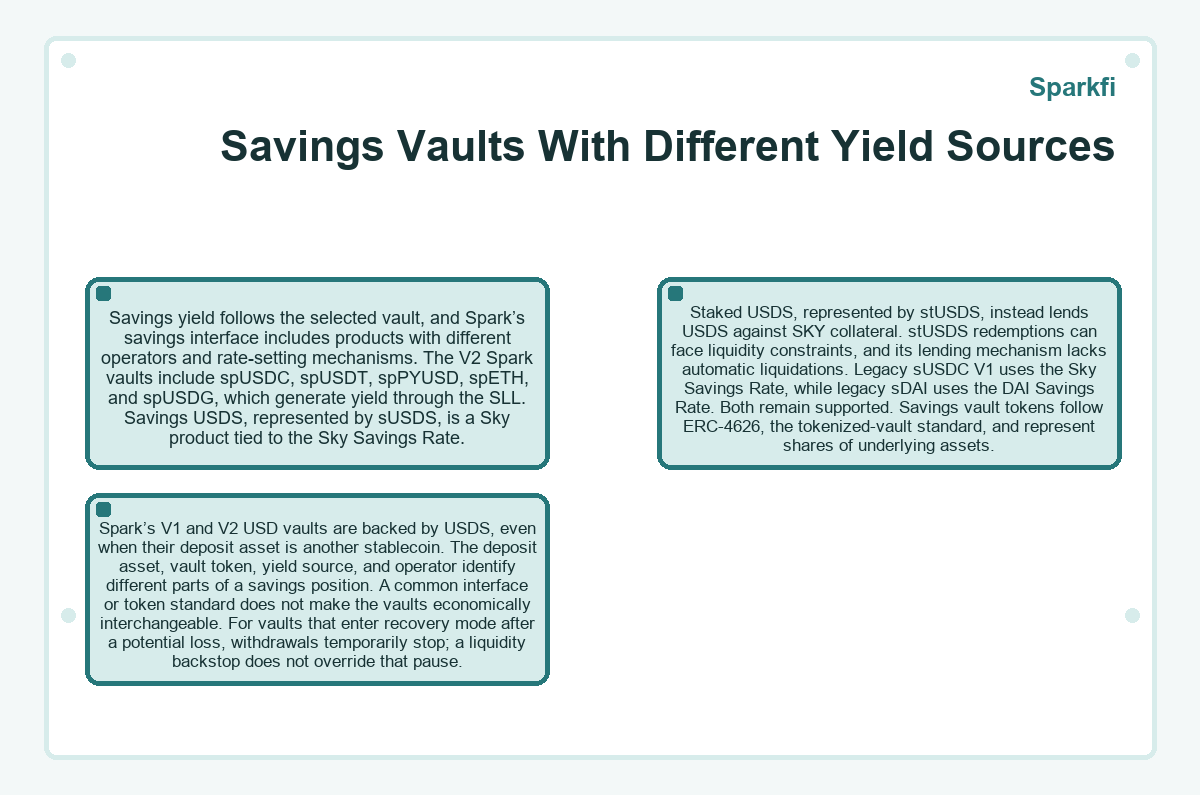
For vaults that enter recovery mode after a potential loss, withdrawals temporarily stop; a liquidity backstop does not override that pause.
Governance Limits and Emergency Controls
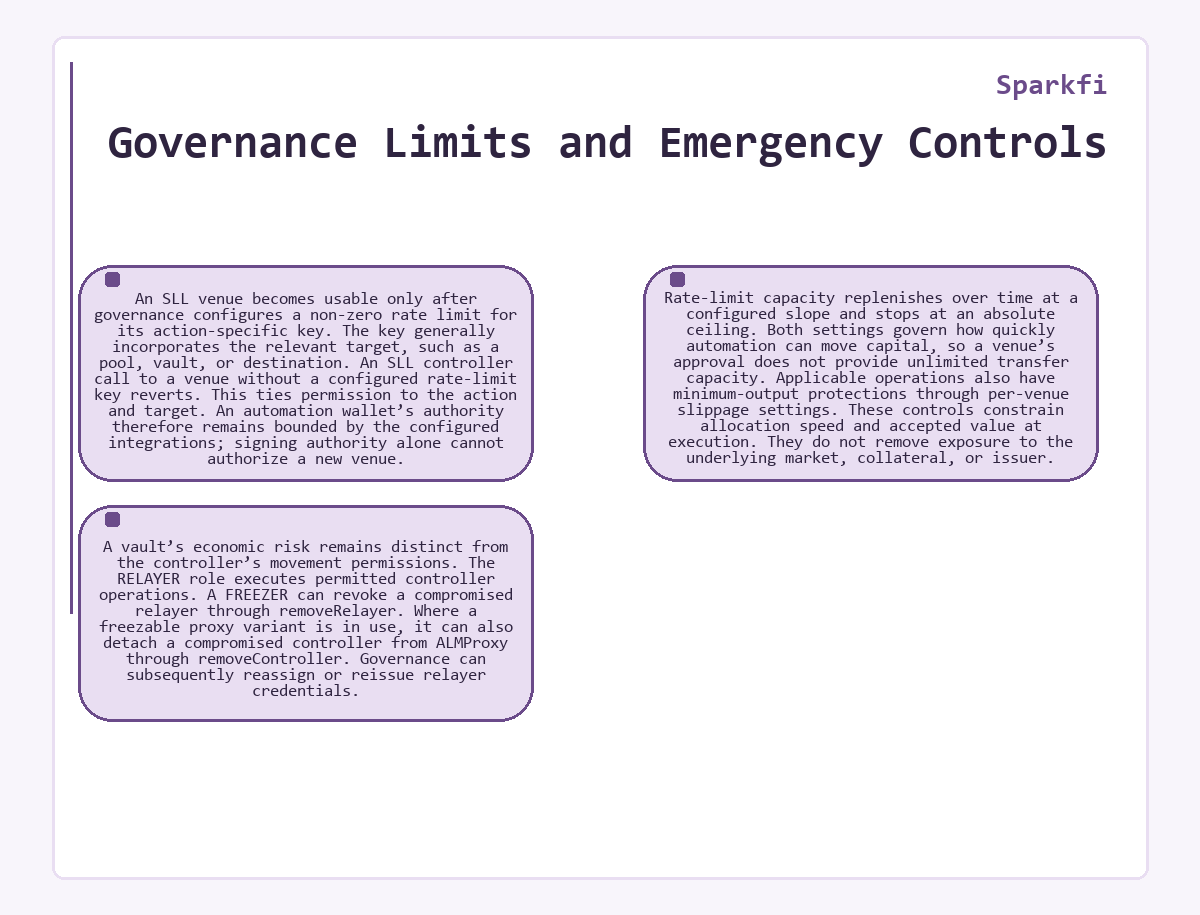
An SLL venue becomes usable only after governance configures a non-zero rate limit for its action-specific key. The key generally incorporates the relevant target, such as a pool, vault, or destination. An SLL controller call to a venue without a configured rate-limit key reverts. This ties permission to the action and target. An automation wallet’s authority therefore remains bounded by the configured integrations; signing authority alone cannot authorize a new venue.
Rate-limit capacity replenishes over time at a configured slope and stops at an absolute ceiling. Both settings govern how quickly automation can move capital, so a venue’s approval does not provide unlimited transfer capacity. Applicable operations also have minimum-output protections through per-venue slippage settings. These controls constrain allocation speed and accepted value at execution. They do not remove exposure to the underlying market, collateral, or issuer. A vault’s economic risk remains distinct from the controller’s movement permissions.
The RELAYER role executes permitted controller operations. A FREEZER can revoke a compromised relayer through removeRelayer. Where a freezable proxy variant is in use, it can also detach a compromised controller from ALMProxy through removeController. Governance can subsequently reassign or reissue relayer credentials.
Withdrawal Liquidity Before Underlying Settlement
The SLL can support a savings withdrawal during an underlying redemption if capital can reach the approved vault within its configured limits. In this hypothetical case, a depositor needs withdrawal funding before an underlying redemption finishes. The Spark Savings vault permits withdrawals, and available SLL funds and rate-limit capacity permit a backstop injection. The allocator sends the permitted capital into the vault, which now has additional liquidity that can support the depositor’s withdrawal.
Funding the vault does not itself pay the depositor; the withdrawal still needs to complete. If vault permissions, approvals, available funds, or rate-limit capacity change, the backstop may no longer supply that access. A withdrawal funded solely by the underlying redemption must wait for that settlement.
Network Coverage and Market Monitoring
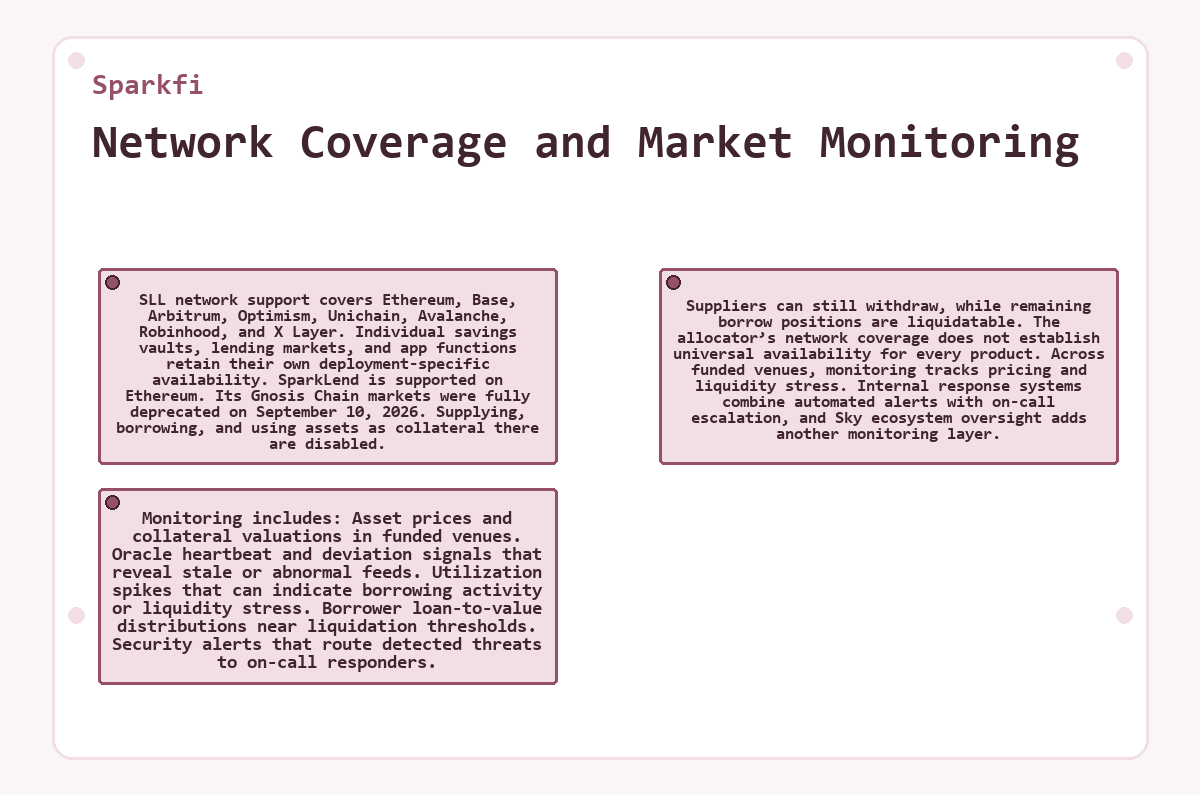
SLL network support covers Ethereum, Base, Arbitrum, Optimism, Unichain, Avalanche, Robinhood, and X Layer. Individual savings vaults, lending markets, and app functions retain their own deployment-specific availability. SparkLend is supported on Ethereum. Its Gnosis Chain markets were fully deprecated on September 10, 2026. Supplying, borrowing, and using assets as collateral there are disabled. Suppliers can still withdraw, while remaining borrow positions are liquidatable. The allocator’s network coverage does not establish universal availability for every product. Across funded venues, monitoring tracks pricing and liquidity stress. Internal response systems combine automated alerts with on-call escalation, and Sky ecosystem oversight adds another monitoring layer. Monitoring includes:
- Asset prices and collateral valuations in funded venues.
- Oracle heartbeat and deviation signals that reveal stale or abnormal feeds.
- Utilization spikes that can indicate borrowing activity or liquidity stress.
- Borrower loan-to-value distributions near liquidation thresholds.
- Security alerts that route detected threats to on-call responders.
Institutional Integration and SPK Participation
Institutional services connect Spark’s capital infrastructure to exchanges, custodians, fintechs, stablecoin issuers, and onchain applications. Institutional Credit covers custody-integrated borrowing; Liquidity as a Service supports stablecoin liquidity infrastructure. Spark Prime uses Arkis portfolio margin technology and SLL liquidity for institutional margin lending across DeFi and centralized finance. Embedded Finance lets other platforms offer onchain earn programs using Spark’s savings infrastructure. These services extend the savings, credit, and allocation system beyond a standalone wallet interface. An integration can present Spark-powered financial products inside another platform, while the underlying savings or lending mechanism retains its own product constraints.
SPK is Spark’s native governance and staking token. Its governance role includes signaling and sentiment checks through Snapshot voting. SPK staking uses Symbiotic infrastructure and secures token bridges within the SLL; other product-security uses remain prospective. Stakers earn Spark Points, and the stake carries product-dependent slashing risk. Spark Points accrue for eligible actions, while Spark Rewards offers token rewards through periodic campaigns. Rewards campaign eligibility and claim deadlines vary. Holding a vault token concerns a share of a savings product, while SPK participation concerns token governance, staking, or rewards. The SPK Farm accepts USDS deposits that earn SPK tokens. Those funds do not earn the Sky Savings Rate simultaneously.
Questions people ask about Sparkfi
What Does maxSlippage Mean in the SLL Controller?
The SLL’s maxSlippage setting is a minimum-value ratio for supported Curve, Uniswap V4, Aave, and over-the-counter operations. A value of 0.999e18 requires at least 99.9% of expected value; zero disables the integration. Each relevant pool, aToken, or exchange needs its own non-zero configuration. This is the controller’s convention, rather than an assumed setting for every user-facing swap.
How Many OTC Swaps Can the SLL Leave Outstanding?
The SLL permits one outstanding over-the-counter swap per whitelisted exchange through its dedicated OTCBuffer contract. A further send to that exchange remains blocked until the previous swap has been claimed back. Slippage checks and configurable recharge requirements also apply. The limit concerns each exchange’s outstanding exposure, so it is not a single system-wide allowance.
Can the SLL Bridge USDC Across Networks?
The SLL supports USDC bridging through Circle CCTP, with governance and controller configuration limiting the routes that automation can use. It also supports per-asset OFT bridging through LayerZero. These are distinct integration types, so support for one asset or destination does not establish support for every token, network pair, or user-facing bridge route.
Is the SLL Automation Safe a Custody Wallet?
The 1-of-2 Safe used by SLL automation does not custody the allocated funds. It batches transactions and allows rotation of the second signer’s hot-wallet key. Its authority remains limited to allocating capital among governance-approved venues through controller constraints. The signer threshold describes this automation wallet, rather than a universal approval threshold for Spark governance or withdrawals.
Which Stablecoin Conversions Are Supported by the SLL?
The SLL supports 1:1 conversion between USDS and DAI in both directions, plus USDS minting and burning through the Sky allocation system. Its integrations also include mainnet PSM swaps between USDS and USDC, and PSM3 deposits and withdrawals on supported layer-2 networks. These are separate controller operations with their own applicable approvals and limits.
When Did the SPK Airdrop Claim Period End?
The final claim date for the SPK airdrop and pre-farming rewards was December 17, 2025. That date concerns those distributions, rather than an expiry date for SPK staking or every Spark rewards program. Airdropped SPK can no longer be claimed through that concluded process. A page advertising reopened claims for that distribution contradicts its closed status.
Are All Uniswap V4 Pools Eligible for SLL Allocations?
The SLL’s Uniswap V4 integration is restricted to 1:1 stablecoin pools without hooks. Supported operations include position minting, position increases and decreases, and swaps. Governance-configured tick limits and a non-zero per-pool slippage setting constrain that integration. A pool’s use of Uniswap V4 alone does not meet those additional conditions.
How Long Does Withdrawing Staked SPK Take?
Queued SPK withdrawals become claimable after two to four weeks under Spark’s two-week Symbiotic epoch configuration. Eligibility begins after the current epoch and the following epoch finish. The app shows the claim time, and a finalization transaction releases the queued stake after the delay. Spark Points continue accruing in the withdrawal queue. The stSPK token represents the stake and is required for withdrawal.